
Dissertation Ruminations, Pt. V
Summa Theologiae IIIa q. 10, a. 4; Excerpt from Chapter I on St. Thomas’ Treatment of the Beatific Vision in Christ

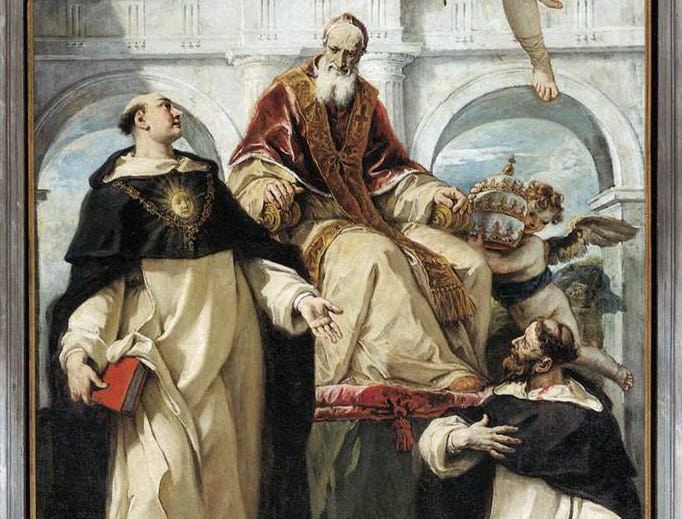
I have been asked to publish some of my dissertation on the beatific vision in Christ as the principle of the vision of the elect and subsequent deification. I will post pieces of it over time for those interested in my research. I have done very little to clean this up from its original submission and have not added further explanations. This is just offered for the interest of the few who may find it edifying. I reserve the right to publish the entirety of the text at a future date, in which case, this series may need to come down.
Article 4
We proceed to the final article of Question 10. The question asks whether the soul of Christ sees the Divine Essence more clearly than any other creature. It is fitting that this is the last question asked in this particular set of articles. St. Thomas leaves this question until the end as a type of culmination in the study of the beatific vision in Christ. So far, Thomas has addressed the way in which the soul of Christ sees the Word as well as the content of the vision of the Word that the soul of Christ enjoys. Here, Thomas places a question ordered toward the quality of the vision compared to that of the blessed in heaven. This is an essential question to address in analyzing the effect that the beatific vision in Christ has on the deification of man. Looking toward the deification of man, St. Thomas explains in this article that Christ’s vision of God is greater than any creature who has been graced with the beatific vision. St. Thomas builds upon what he has said before in question nine when he said, “And hence it was necessary that the beatific knowledge, which consists in the vision of God, should belong to Christ pre-eminently, since the cause ought always to be more efficacious than the effect.”1 It is specifically in the pre-eminence of this vision that it is able to be the cause of our own beatific vision.2 Christ’s vision must be greater than all others “since the cause ought always to be more efficacious than the effect.”3 In sum, the conclusion that St. Thomas comes to in this present article is the foundation for the argument of this thesis, that Christ’s vision is the cause of man’s beatific vision.
This article contains three objections to the question. The first objection considers the medium of knowing as that which makes knowing better in one subject greater than another. The objector says, “But all the blessed see the Word immediately in the Divine Essence Itself, as was said in the First Part. Therefore, the soul of Christ does not see the Word more perfectly than any other creature.”4 This objection presupposes that Christ and the blessed view the Word in the same way, and thus, they would view the Divine Essence to the same degree. The second objection centers on the human soul of Christ being less than the angels. It says, “Further, the perfection of vision does not exceed the power of seeing. But the rational power of a soul, such as in the soul of Christ, is below the intellective power of an angel…”5 Here we can see that the objector is comparing the human soul of Christ to that of the intellective power that the angels possess. By nature, the human soul is less than the angels. According to the objector, that should clearly show that the soul of Christ could not view the beatific vision more perfectly than the angels. Finally, in objection three, the objector cites the view that God has of His Word. The objector says that “God sees His Word infinitely more perfectly than does the soul of Christ. Hence, there are infinite possible mediate degrees between the manner in which God sees His Word and the manner in which the soul of Christ sees the Word.”6 Similarly to the second objection, this argument compares the human soul of Christ to God and correctly shows the inequality that a human soul, even that of Christ, has with God. The purpose of this objection, though, is not to specifically consider God, since God is not a creature, but to consider these “infinite possible mediate degrees” between the human soul of Christ and God. The objector seems to be saying that since there are these infinite degrees, theoretically, another creature could possess one of those degrees and could therefore see the Word more perfectly than the human soul of Christ. This possibility leads the objector to at least doubt the validity of the affirmative to this question.
To respond to these objections, Thomas turns to St. Paul and his letter to the Ephesians. St. Paul says that God has made Christ to “sit at His right hand in the heavenly places, far above all rule and authority and power and dominion, and above every name that is named, not only in this age but also in that which is to come…”7 Thomas cites St. Paul here to put the exaltation of Christ into perspective. Christ has been placed above all of creation, specifically, St. Paul cites three of the nine choirs of angels.8 Thomas explains these nine choirs at length in the angelic hierarchy in his Commentary on Ephesians. It is too much to explore for this work, but it does benefit us to look at certain points of the commentary to bring to light why this passage was chosen by Thomas to refute the objections stated in this article. Thomas makes the comment, “Setting Him on His right hand refers to the second element in Christ’s exaltation. This height of glory can be viewed in three perspectives: in its relation to God, to material creatures, and to spiritual creatures.”9 Thomas begins with Christ being set at the right hand of God. This has traditionally been interpreted as a position of authority and power.
The right hand is taken as a nobler and stronger part of man; so when we say that Christ Jesus is seated at the right hand of God, it should be understood that according to His humanity He partakes of the Father’s choicest blessings, and according to His divinity it is understood as equality with the Father.10
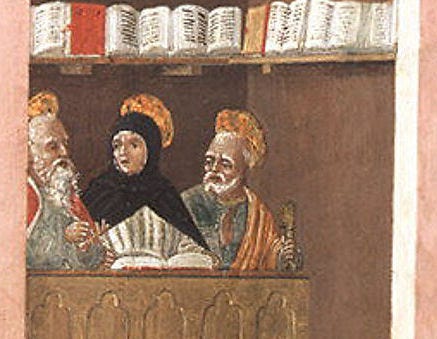
The importance of this exegesis cannot be overstated. For this present work, we will specifically consider Christ’s humanity. Thomas tells us that Christ’s humanity being seated at the right hand of the Father means that Christ, in His humanity, receives the height of grace from God. This extends to the beatific vision as well. Thomas is interpreting St. Paul to say that the beatific vision, which is a grace from God, that the human soul of Christ enjoys, is higher than any other creature. He goes on to say that this degree is higher than both material creatures as well as spiritual creatures, “In relation to spiritual creatures, he first mentions that Christ is exalted over certain specific ones, and second, over all of them generally, above every name.”11 This confirms that the humanity of Christ is set above all other creatures, both on the earth, i.e., humans, as well as those in heaven, i.e., the saints and angels.12
Thomas continues, “But in heavenly glory, the higher anyone is, the more perfectly does he know God. Therefore, the soul of Christ sees God more perfectly than does any other creature.”13 He returns to an answer he gave in article two, concentrating on the place in heaven that a beatified soul occupies. As was cited above, Thomas tells us that the more a soul is confirmed in the virtue of charity, the higher place in heaven they occupy, and the more perfectly they view the beatific vision.14 Christ certainly occupies the highest place in heaven as the Father has Him, “sit at His right hand...”15
Moving on to the Respondeo section, we return to the subject of a habitus that St. Thomas explored in De veritate. Thomas addresses the way in which the beatific vision is mediated to the beatified soul. He says, “The vision of the Divine Essence is granted to all the blessed by partaking of the Divine Light which is shed upon them from the fountain of the Word of God.”16 Additionally, Thomas clarifies in the reply to the first objection, “Perfection of knowledge, on the part of the thing known, depends on the medium; but as regards the knower, it depends on the power or habit.”17 I want to take these two quotes together as they illustrate one picture. The blessed in heaven partake, one would also say participate, in the Divine Light that is shed upon them through the Word. The human soul of Christ is hypostatically united to the Word, and thus, His proximation to the Word is far greater than any other creature.18 This allows Him to “… more fully receive the light in which God is seen from the Word Himself.”19 The manner in which this is done is elucidated in the reply to the first objection, through the means of the habitus. In sum, the beatific vision is communicated by God through the Word by means of a habitus to the human soul in Christ. In union with the humanity of Christ, all of the blessed receive the beatific vision poured out upon them, like light being shed by the Word Himself. Again, as Thomas says, Christ is the cause of man’s beatific vision.
ST IIIa q. 9, a. 2.
This is due to the order of grace according to Garrigou-Lagrange, “And hence the degrees thereof depend rather on the order of grace, in which Christ is the supreme, than on the order of nature, in which the angelic nature is placed before the human.” Christ the Savior, 374.
ST IIIa q. 9, a. 2. Emphasis is mine.
ST IIIa q. 10, a. 4.
ST IIIa q. 10, a. 4.
ST IIIa q. 10, a. 4.
Eph. 1:20-21.
See Saint Thomas Aquinas, Commentary on the Letters of Saint Paul to the Galatians and Ephesians, Translated by F.R. Larcher, OP and M.L. Lamb, Edited by J. Mortensen and E. Alarcon, (Landor, WY: The Aquinas Institute for the Study of Sacred Doctrine, 2012) Commentary on Ephesians C. 1, L. 7, Sections 61-62.
Commentary on Ephesians, C. 1, L. 7, Section 60. Cf. Psalm 110:1. St. Jerome also comments on this passage, “[St. Paul] demonstrates the power of God through a human image. It is not that a material throne is set up and God the Father is physically seated on it and has the Son seated above with him. Rather, he communicates with this metaphor because we could not understand his role as incomparable governor and judge except in our own terms… Being on the right or left of God is to be understood as meaning that saints are on his right but sinners on his left… The very word ‘sits’ denotes the power of kingship, through which God confers benefits on those whom he is seated. He has reined them in and has them in his service, guiding those who had previously strayed.” “Commentary on the Epistle to the Ephesians,” The Word on Fire Bible: Acts, Letters, and Revelation, In page commentary, (Park Ridge, IL: Word on Fire Catholic Ministries, 2022) 373-374.
Commentary on Ephesians, C. 1, L. 7, Section 60.
Commentary on Ephesians, C. 1, L. 7, Section 60.
While St. Paul only mentions the middle choirs in the hierarchy, Thomas goes on to make comment that it is because these specific names are in accord with the dignity of the choir, and since he wanted to show that the dignity of the human nature of Christ surpasses the dignity of all other creatures. See Commentary on Ephesians C. 1, L. 7, Section 63.
ST IIIa q. 10, a. 4.
Cf. ST Ia q. 12, a. 6.
Eph. 1:20.
ST IIIa q. 10, a. 4.
ST IIIa q. 10, a. 4. Emphasis is mine.
Garrigou-Lagrange explains, “Therefore, Christ’s soul sees God’s Essence more clearly than the highest angels do. He received the light of glory in a degree that was in proportion to the plenitude of His grace, which is derived from the grace of union.” Christ the Savior, 375.
ST IIIa q. 10, a. 4.
https://allendaves.substack.com/p/most-true-christains-go-to-hell?utm_source=share&utm_medium=android&r=1xhldx